
Introduction: From Science to Strategy
In our last article, [The Psychology of Focus: Why Our Minds Drift and How to Reclaim It], we explored the science of distraction: why our minds wander, how smartphones drain cognitive capacity, and why interruptions leave us stressed.
But knowing why isn’t enough. To truly reclaim focus, we need tools we can use every day. That’s what this Focus Playbook provides: seven practical habits backed by research, plus a simple 7-day experiment you can start immediately.
By following this toolkit, you’ll build a repeatable system to reduce distractions, prevent attention residue, and create the conditions for flow.
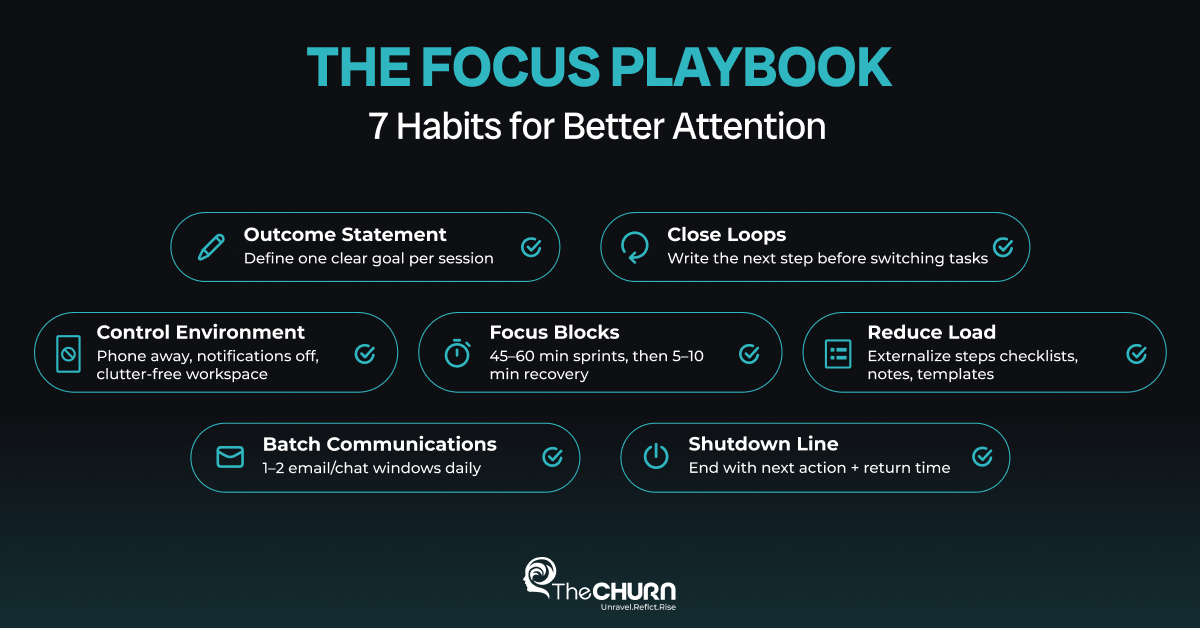
Part 1: The Focus Playbook—7 Practical Habits
1) Write an Outcome Statement
Before each session, write one clear sentence: “By the end of this block, I will have ___.”
- This turns vague goals into concrete outcomes (e.g., “finish slides 3–6”).
- It aligns with flow conditions—giving you clarity and direction.
- Use action verbs and scope your outcome to 45–60 minutes.
- Keep a running log to track daily wins and momentum.
2) Close Loops Before Switching
Every unfinished task creates attention residue. Before switching, jot down the very next step (e.g., “add chart to slide 6 tomorrow at 10 a.m.”).
- This frees mental space and smooths re-entry later.
- Make it a micro-ritual: no switch without closing the loop.
- Over time, this habit reduces mental drag across your day.
3) Control the Environment :
- Put your phone in another room; turn on Do Not Disturb.
- Close extra tabs/apps; keep only essentials visible. In fact, a very less-used feature, if you don't really need to switch tabs is trying to use your app in full screen—automatically hiding other tabs.
- Research shows the mere presence of a phone drains focus (Ward, 2017).
- Tidy your desk or workspace before starting a block.
- When your environment is distraction-proof, focus becomes natural.
4) Work in Focus Blocks
Use 45–60 minute sessions followed by 5–10 minute breaks. Breaks should restore you (stretch, walk, breathe)—not introduce new distractions.
- Start each block with your outcome statement visible.
- If energy dips, shorten blocks to 30–40 minutes and build up.
- Think of these as mental sprints: intense focus, then recovery.
5) Reduce Cognitive Load
Treat working memory as a fragile chalkboard—don’t overload it. Externalize steps using checklists, notes, or templates.
- Break projects into small, visible subtasks with clear next actions.
- Stage files and resources before starting to avoid mid-block searches.
- Freeing memory capacity means more energy for actual thinking.
6) Batch Communications
Stop checking email or chat 30+ times a day. Set 1–2 windows for processing messages in bulk.
- Let your team know your deep-work hours via status updates.
- Use a quick triage system: delete, delegate, defer, or do (<2 mins).
- You’ll discover that “urgent” is rarely urgent.
7) End with a Shutdown Line
- Finish each session by writing the next action and return time.
- Example: “Tomorrow 9:30 a.m. — review feedback section.”
- Capture stray thoughts in 1–2 bullets so they stop looping in your mind.
- Mark the session closed (checkmark, closing doc, timer stop).
- This closure ritual signals your brain it’s safe to let go.
Conclusion: Tools Create the Conditions—Practice Proves Them
Focus is not a personality trait. It’s not discipline, grit, or motivation. It’s the outcome of systems that reduce friction, close mental loops, and protect cognitive energy.
The tools in this Playbook work because they change the environment around your attention. Outcome Statements clarify intent. Focus blocks create boundaries. Shutdown lines restore mental closure. Together, they replace constant reaction with deliberate work.
But tools only matter if they survive real days — meetings, messages, deadlines, and fatigue. The true test of any system is whether it holds up when work gets messy.
That’s why the Playbook doesn’t end here.
Next: The 7-Day Focus Experiment — a simple way to test these tools in your own routine and measure what actually changes.
One week. Minimal friction. Clear evidence of what works for you.
Haven’t read the science behind focus yet? Go back to The Psychology of Focus here →