
From Understanding Focus to Proving It Works
In our original article, [The Psychology of Focus: Why Our Minds Drift and How to Reclaim It], we explored the science behind distraction — why our minds wander, how interruptions create attention residue, and why modern work environments quietly drain cognitive capacity.
In Part I of The Focus Playbook, we translated that science into action: seven practical, research-backed habits designed to protect attention, reduce friction, and create the conditions for flow in everyday work.
But frameworks and habits only matter if they work in real life.
This second part is about proof through practice.
The 7-Day Focus Experiment is a simple, structured way to test the Playbook in your own day-to-day routine. Instead of relying on motivation or willpower, it invites you to observe what actually changes when you redesign your environment, structure your work intentionally, and close mental loops before they spill into stress.
Across one week, you’ll track focus time, task switching, and perceived stress — not to optimize yourself into exhaustion, but to see how small, deliberate changes affect clarity, calm, and output.
By the end of the experiment, you won’t just understand why focus matters or believe the habits help — you’ll have firsthand evidence of what works for you, and a repeatable system you can continue refining.
Let’s run the experiment.
The 7-Day Focus Experiment
A system only works if you test it.
The Focus Playbook is not meant to be admired or memorized — it’s meant to be run. This week-long experiment is designed to help you apply the habits in real working conditions and observe what actually changes when you redesign how you use your attention.
The experiment is intentionally simple. You’re not overhauling your entire life. You’re running a controlled test: same job, same responsibilities — different structure.
Over seven days, you’ll introduce habits gradually, measure a few key signals, and review the results at the end. The goal isn’t perfection. It’s awareness and proof.
Day 1–2: Measure Your Baseline
Before changing anything, you need a clear picture of how your attention currently behaves.
For the first two days, work exactly as you normally do — but track three things:
- Uninterrupted focus minutes
How long can you stay on a single task before switching or getting interrupted? - Number of task switches
Each time you move from one task, app, tab, or context to another, count it. - Stress level (1–5)
At the end of the day, rate how mentally strained or scattered you felt.
Use whatever tracking method feels easiest: a notebook, a stopwatch, a notes app, or a simple spreadsheet. Precision matters less than consistency.
These two days establish your baseline — the reference point you’ll compare against later. Most people are surprised by how short their focus windows are and how often they switch without realizing it.
Day 3–5: Apply the Core Habits
Now you begin the experiment.
For the next three days, introduce the core habits from the Focus Playbook:
- Keep your phone out of sight
Ideally in another room, or at least out of reach and face-down. - Write an Outcome Statement before each session
One clear sentence describing what “done” looks like for that block. - Run two focused work blocks per day
Each block should be 45–60 minutes, followed by a short restorative break.
Continue tracking the same metrics as before: focus minutes, task switches, and stress level.
At this stage, don’t aim for flawless execution. The goal is to notice differences. Many people report smoother sessions, fewer impulsive switches, and a subtle drop in mental tension — even with just these changes.
Day 6–7: Add Advanced Habits
In the final two days, layer in the advanced habits to complete the Playbook:
- Batch email and chat
Limit communication to one or two designated windows instead of constant checking. - End each session with a Shutdown Line
Write the next action and return time so your brain doesn’t keep the task open.
Keep tracking your metrics daily.
By Day 7, you’re operating with the full system in place — not forcing focus through willpower, but designing conditions that make focus easier to sustain.
Repeat it for 3 more weeks - so more like a 21 day course. With each progressing day - introduce an atomic habit to your lifestyle.
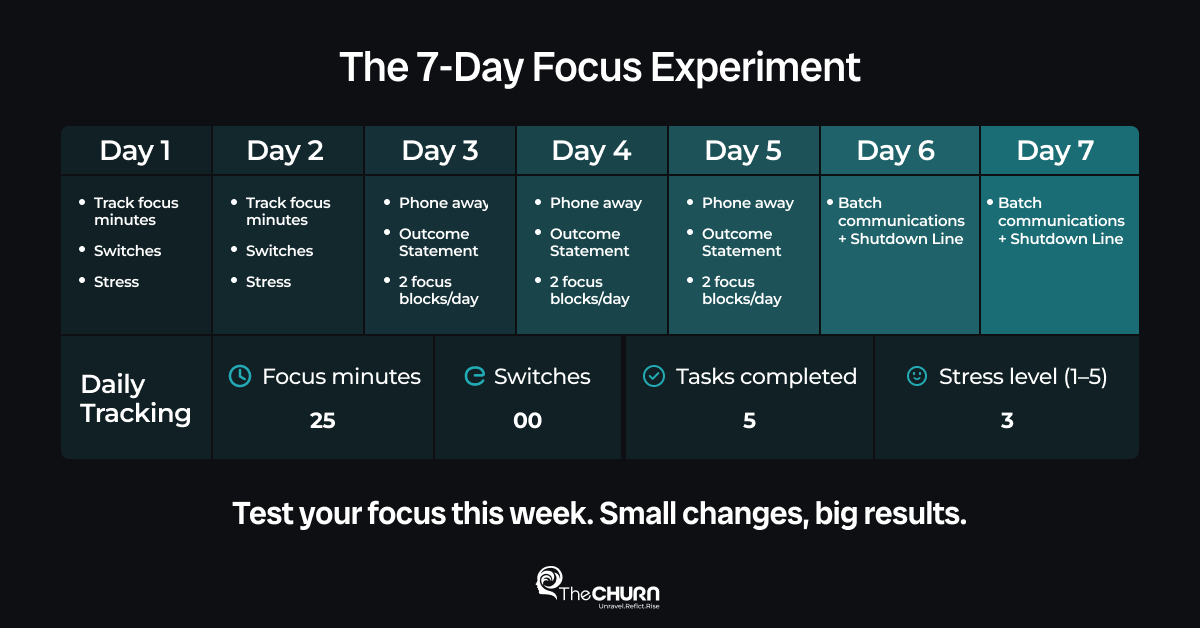
Daily Tracking Template
Each day, capture the following:
- Focus minutes per block
- Number of task switches
- Tasks completed (based on Outcome Statements)
- Stress rating (1–5)
This data doesn’t need to be perfect. It just needs to be honest.
Review Your Results
At the end of Day 7, compare your baseline (Days 1–2) with your final results.
Ask yourself:
- Did average focus time increase?
- Did task switching decrease?
- Did stress levels change?
- Did tasks feel easier to complete?
The goal isn’t to keep every habit forever. Keep what clearly worked. Modify or drop what didn’t fit your role or rhythm.
Why This Experiment Works
- Progressive design → habits are introduced gradually.
- Data-driven → tangible proof of improvement keeps motivation high.
- Flexible → adapts to any role or schedule.
- Reinforcing loop → early wins build momentum for long-term change.
Conclusion: Design, Don’t Force, Your Attention
Distraction is the default in modern work. Focus must be designed.
The Focus Playbook provides small, structural habits that reclaim your most valuable resource — attention. Start with just one step: write an Outcome Statement or put your phone in another room. Build from there.
Within a week, you’ll see how much smoother and calmer your days feel. The experiment isn’t about perfection — it’s about creating conditions where focus becomes natural.
Haven’t read the science behind focus yet? Go back to The Psychology of Focus here →