
Focus Is the New Superpower
In today’s fast-paced, always-on world, the ability to focus has become a professional superpower. Yet, for most of us, focus feels fleeting. We bounce between email, Slack notifications, text messages, and meetings — ending the day exhausted, but with little deep work accomplished.
The truth is, our brains weren’t designed for constant connectivity. Modern tools promise productivity but often undermine it by fragmenting our attention. To reclaim control, we need to understand why our minds drift in the first place. Research from psychology and neuroscience paints a clear picture — and reveals why protecting focus is critical for both performance and well-being.
What Does “Focus” Really Mean?
Focus isn’t just “paying attention.” In psychology, it refers to the ability to direct mental resources toward a single task while filtering out competing stimuli.
Two elements make up true focus:
- Sustained attention — the ability to stay with one task long enough to make meaningful progress.
- Cognitive control — the ability to filter distractions and resist impulses.
Both rely on working memory, the limited “mental scratchpad” where we hold and manipulate information. Each interruption — a phone buzz, a passing thought — occupies part of that scratchpad, leaving fewer resources for the task at hand.
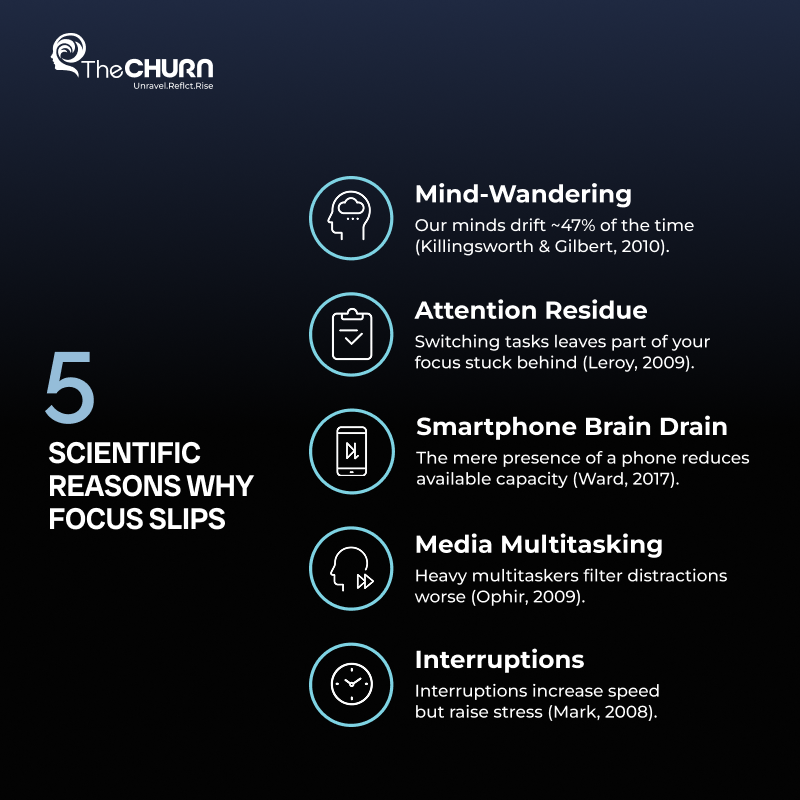
Why Our Minds Drift: The Science of Distraction
1. Mind-Wandering Reduces Happiness
A landmark study by Matthew Killingsworth and Daniel Gilbert (Science, 2010) found that people’s minds wander nearly 47% of the time. More importantly, they reported being less happy when their minds wandered — regardless of what they were thinking about. A wandering mind isn’t just unproductive, it’s also less content.
2. Attention Residue Slows Us Down
In 2009, Sophie Leroy described attention residue: the phenomenon where switching tasks leaves part of your attention stuck on the previous task. This leftover focus makes it harder to fully engage with the new task, reducing performance. It’s why checking email mid-project leaves you sluggish afterward.
3. Smartphones Drain Cognitive Capacity
Adrian Ward and colleagues (2017) discovered the “brain drain” effect: even the mere presence of a smartphone — turned off, face down, on your desk — measurably reduces available cognitive capacity. Simply seeing your phone competes for mental resources. Keeping it in another room restores focus.
4. Multitasking Weakens Cognitive Control
Stanford researchers Ophir, Nass, and Wagner (2009) found that heavy media multitaskers perform worse at filtering distractions and task-switching. Ironically, those most confident in their multitasking ability are often the least effective at it.
5. Interruptions Increase Stress
Gloria Mark’s team at UC Irvine (2008) showed that interruptions cause people to speed up to “catch up,” but this only raises stress and frustration — with no improvement in quality. In short: interruptions make us busier, not better.
How Focus Works When It Works: Flow
If distractions sabotage focus, what allows it to thrive? The answer lies in flow, a concept introduced by psychologist Mihaly Csikszentmihalyi. Flow is the state of complete immersion in a task, where time seems to disappear and performance peaks.
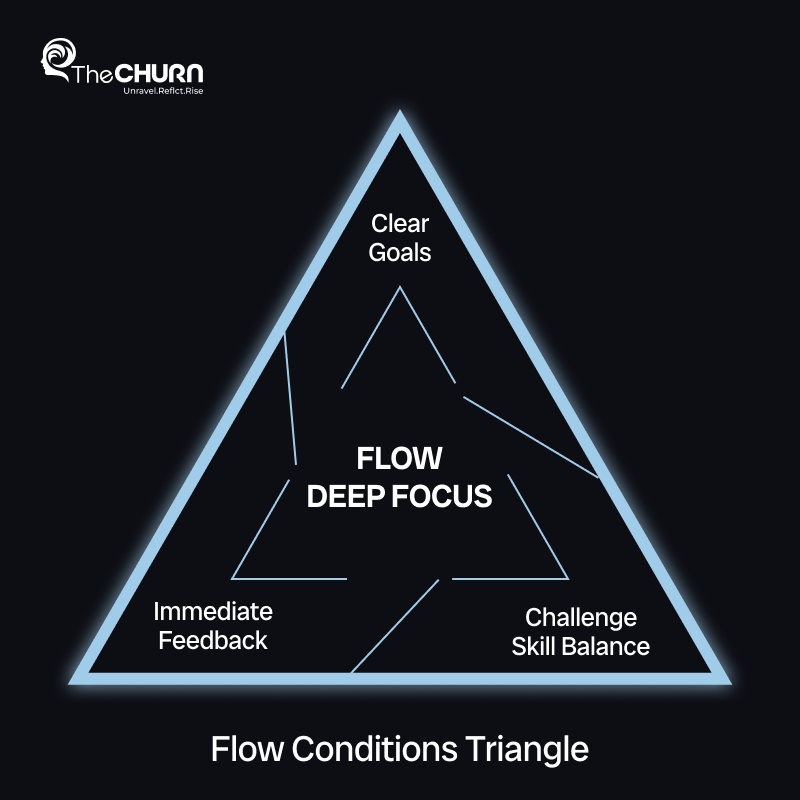
Three conditions create flow:
- Clear goals — you know what success looks like.
- Immediate feedback — progress is visible in real time.
- Challenge–skill balance — the task stretches you but doesn’t overwhelm.
Think of a developer solving a coding problem or an athlete in the middle of a game. Flow is not about grinding harder; it’s about designing conditions that make deep engagement possible.
How Focus Works When It Works: Flow
If distractions sabotage focus, what allows it to thrive? The answer lies in flow, a concept introduced by psychologist Mihaly Csikszentmihalyi. Flow is a state of deep immersion where you’re so absorbed in the task that time fades, self-consciousness dissolves, and performance peaks.
Three key conditions make flow possible:
- Clear goals — Flow thrives on clarity. When you know exactly what you’re aiming for, your mind stops scattering energy on “what’s next?” or “am I doing this right?” Instead, it directs full attention to execution. These goals don’t need to be monumental — they can be as simple as finishing a paragraph, mastering a chord progression, or reaching the next milestone in a project. What matters is that the destination is visible and attainable.
- Immediate feedback — Flow depends on a constant loop of action and response. Every keystroke, brushstroke, or musical note offers instant signals about whether you’re moving in the right direction. This feedback keeps motivation alive, because you can adjust in real time rather than waiting for a distant outcome. In sports, it’s the bounce of the ball; in music, it’s the harmony (or disharmony) you hear the moment you play.
- Challenge–skill balance — Flow emerges in the sweet spot between boredom and anxiety. If the task is too easy, your mind drifts. If it’s too difficult, frustration overwhelms you. The magic happens when the challenge stretches your abilities just enough to demand focus, but not so much that it feels impossible. It’s the mental equivalent of a workout that leaves you sweaty but not broken.
Think of a musician practicing a piece that sits just beyond their current ability. The score provides clear direction (goal), the sound produced gives instant feedback, and the difficulty level is high enough to be engaging but not paralyzing. Hours pass unnoticed as skill and concentration merge.
Flow isn’t about grinding harder or longer; it’s about engineering the conditions that let attention lock in effortlessly.
Why Protecting Focus Matters
Picture this: You sit down to write an important report. Within minutes, a notification pings. You glance at your phone. A message pulls you into a side conversation. By the time you return, the thread of thought is gone. You try to recover by working faster, but the stress creeps in. Soon the quality slips, frustration rises, and the cycle repeats: more interruptions → faster pace → rising stress → lower performance → even more distractions.
Now imagine the opposite. You carve out a block of time with no alerts, no side chatter. The goal is clear. Each paragraph builds on the last, giving you instant feedback. The challenge stretches you, but not beyond your limits. Hours pass unnoticed, and the final product doesn’t just meet the deadline — it carries the satisfaction of work done deeply well.
That’s the difference protecting focus makes. It isn’t about squeezing more hours out of the day; it’s about breaking the distraction cycle and creating the conditions for clarity, calm, and meaningful productivity.
Conclusion
Focus is no longer optional — it’s the currency of modern work. Research shows our attention is fragile, constantly hijacked by mind-wandering, technology, and interruptions. But by understanding how focus works, we can reclaim it.
The science is clear: focus doesn’t depend on willpower alone. It depends on structure, habits, and design. Protect it like an asset, and you’ll unlock not just better productivity, but a calmer, happier mind.